How to Heal from Childhood Trauma as an Adult: A Gentle Guide
Navigating the echoes of childhood trauma in adulthood can feel isolating, but you're not alone. This is a gentle space to explore what it means to come back to yourself and find your footing again.
Part of our guide to what generational trauma is and how to break the cycle.
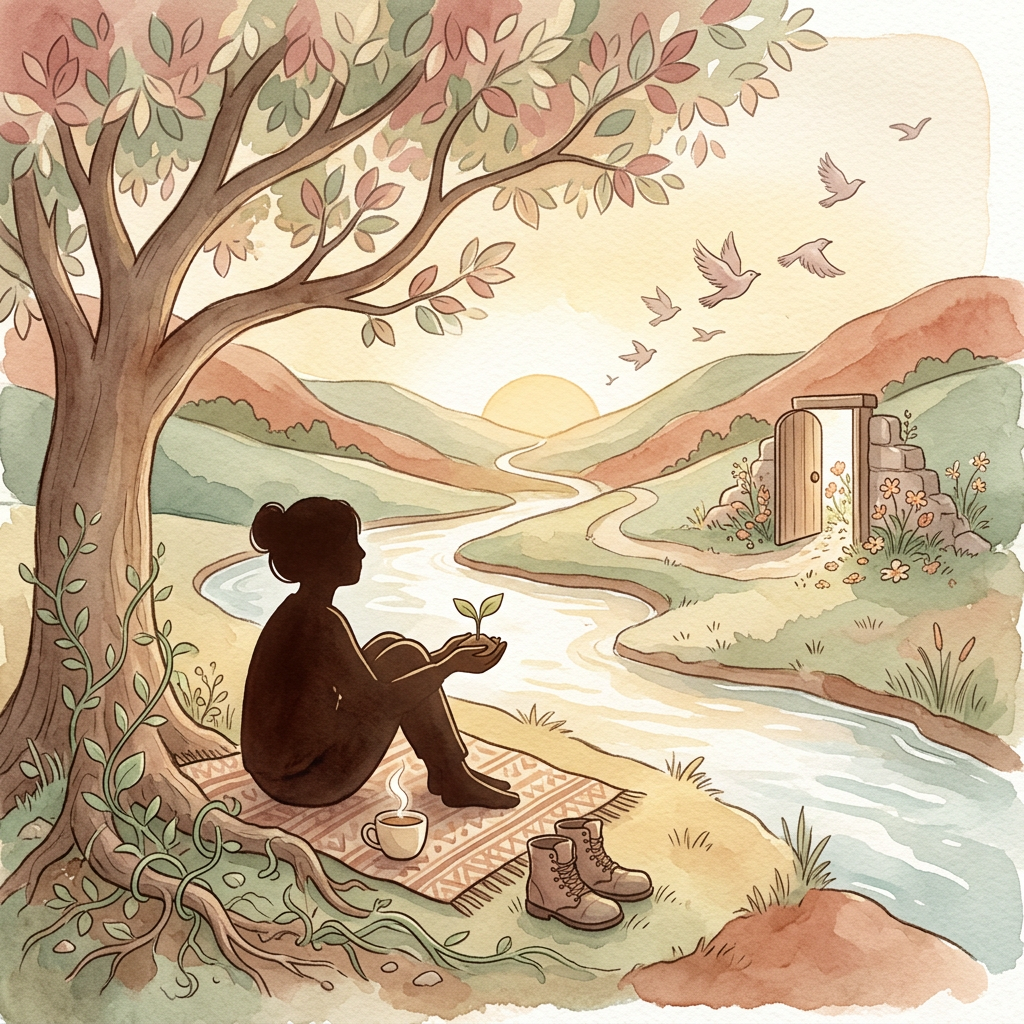
If you are here, reading these words, chances are you're carrying something from your past. The journey of understanding how childhood trauma shows up in adulthood is a quiet, often confusing one, but you don't have to walk it alone. We're here to walk alongside you. At Recovery Trauma™, we believe that coming back to yourself is always possible, one gentle step at a time. This isn't about erasing the past, but about learning to live more fully in the present.
Recognising Childhood Trauma in Adulthood
Adverse childhood experiences (ACEs) are not always big, dramatic events. Sometimes trauma is the absence of what we needed: the lack of emotional safety, consistent care, or the freedom to be ourselves. As adults, the echoes of these experiences can surface in ways that are hard to connect back to our early years.
Childhood trauma in adulthood might show up as a constant feeling of anxiety, a harsh inner critic that never quiets, or a deep sense of being different from everyone else. It can look like difficulty in relationships—perhaps you find it hard to trust, get too close too quickly, or avoid connection altogether. It can also live in the body as chronic pain, fatigue, or a persistent feeling of being on-edge. Recognising these patterns isn't about labelling yourself; it's the first step in understanding your own story with compassion.
It's About Understanding, Not Blame
When we start to look at our past, it can be tempting to fall into a cycle of blame. But recovery often becomes more possible when we shift our focus from 'who is to blame?' to 'what happened to me, and how did it affect me?'. Many of our caregivers were doing the best they could with the tools they had, often carrying their own unacknowledged trauma.
Understanding this isn't about excusing hurtful behaviour. It's about recognising that your young nervous system adapted to its environment to survive. Your attachment patterns—the ways you learned to connect with others for safety—were shaped by your early relationships. Seeing these patterns as clever survival strategies, rather than personal flaws, can be a profoundly powerful shift.
Steps Toward Wellbeing After Trauma
There is no single map for what comes next, as each person's path is unique. However, there are some gentle principles that many find supportive in their recovery from childhood trauma. The key is to move slowly and listen to your own system.
- Start with tiny moments of safety. Recovery isn't a race. It might begin with simply noticing one moment in your day when you feel even 1% more at ease. Maybe it's the warmth of a cup of tea or the quiet of the early morning.
- Gently turn toward the body. Trauma often makes us feel disconnected from our bodies. Somatic (body-based) practices are not about forcing yourself to 'feel your feelings', but about gently noticing physical sensations without judgment. What does the chair feel like beneath you? Can you feel your feet on the ground?
- Practise self-compassion. Your inner critic was likely born as a way to try and keep you safe. You can acknowledge its intention while gently choosing a kinder inner voice. Ask yourself, 'What would I say to a dear friend in this situation?'
- Learn the shape of your 'no'. For many survivors, saying 'no' and setting boundaries feels impossible or dangerous. Start small, in low-stakes situations. Practising this helps rebuild a sense of agency and self-trust.
Finding Safe Spaces for Your Story
You do not have to do this work in isolation. In fact, connection is often where the deepest wellbeing happens. Relational trauma often needs relational repair. This can happen in a safe friendship, with a trusted partner, or in a support group with other survivors who 'get it'.
Working with a trauma-informed therapist can also be an invaluable part of your journey, providing a dedicated space to explore your story with professional support. While platforms like ours can offer community and understanding, they are not a replacement for professional therapy. Finding the right kind of support for you is a courageous act of self-care.
A Gentle Note on Your Safety
Exploring these topics can sometimes bring up difficult feelings or memories. Please go at your own pace. If at any point you feel overwhelmed, give yourself permission to pause, step away, and do something that helps you feel more grounded. Your safety is the priority. If you are in crisis, please know that immediate support is available. You can call Samaritans for free at any time on 116 123.
What to try today: Take a moment right now to notice three things in the room around you. Name their colour or texture: the smooth, cool glass of the window; the soft, blue fabric of a cushion; the dark grain of the wooden table. This simple act can help gently bring your awareness back to the present moment.
Navigating the impact of adverse childhood experiences is a journey of coming home to yourself. It's often non-linear, with steps forward and steps back, and that's okay. Be gentle with yourself. Every moment you choose to understand your story, to offer yourself a sliver of kindness, or to reach out for support is a radical act of hope and recovery.
Practices that go with this article
These guided practices are part of Recovery Trauma™ membership. They were chosen to match what you have just been reading.
Ready to put what you've learned into practice?
Recovery Trauma™ gives you access to guided exercises, grounding and nervous-system practices, journals, healing journeys, assessments and other recovery resources — all in one place.
Join Recovery Trauma™Already a member? Sign in to go straight there.
Sources & further reading
- Complex PTSD — NHS
- NHS Talking Therapies — NHS
These sources are for general education. Recovery Trauma™ does not diagnose or treat — please speak to a qualified professional about your own situation.
Cite this article: Recovery Trauma™ (2026). “How to Heal from Childhood Trauma as an Adult: A Gentle Guide.” Recovery Trauma™. https://recoverytrauma.com/blog/how-to-heal-from-childhood-trauma-as-an-adult
Keep going with Recovery Trauma™
Wellbeing is not something you do alone. Here's what's next.
Keep reading
Related articles
Attachment
Fear of Abandonment: Why Closeness Can Feel Dangerous
Abandonment fear is a nervous-system prediction, not a character flaw. Why it forms, how it shows up in adult relationships, and what actually calms it.
Attachment
Trauma Bonding with a Parent: When Family Isn't Safe
Trauma bonding with a parent can leave us longing for closeness with the same person we may need protection from